Regional Phillips Curve in a Small Open Economy: Evidence from Bolivia
Feb 25, 2026· ·
0 min read
·
0 min read
Roger Mario López Justiniano
Abstract
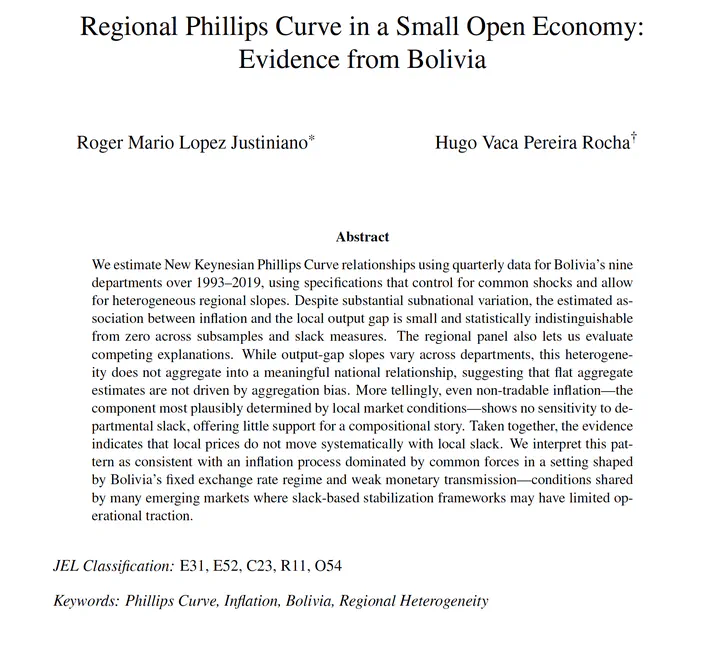
We estimate New Keynesian Phillips Curve relationships using quarterly data for Bolivia’s nine departments over 1993–2019, using specifications that control for common shocks and allow for heterogeneous regional slopes. Despite substantial subnational variation, the estimated association between inflation and the local output gap is small and statistically indistinguishable from zero across subsamples and slack measures. The regional panel also lets us evaluate competing explanations. While output-gap slopes vary across departments, this heterogeneity does not aggregate into a meaningful national relationship, suggesting that flat aggregate estimates are not driven by aggregation bias. More tellingly, even non-tradable inflation—the component most plausibly determined by local market conditions—shows no sensitivity to departmental slack, offering little support for a compositional story. Taken together, the evidence indicates that local prices do not move systematically with local slack. We interpret this pattern as consistent with an inflation process dominated by common forces in a setting shaped by Bolivia’s fixed exchange rate regime and weak monetary transmission—conditions shared by many emerging markets where slack-based stabilization frameworks may have limited operational traction.
Type